After many years of working with internationally trained dentists preparing for the INBDE in the United States, I have seen a clear set of patterns emerge.
Some candidates pass on their first attempt with confidence. Some struggle with multiple attempts before finding their footing. And looking at these two groups honestly, the differences almost never come down to raw intelligence or dental knowledge. They come down to preparation approach.
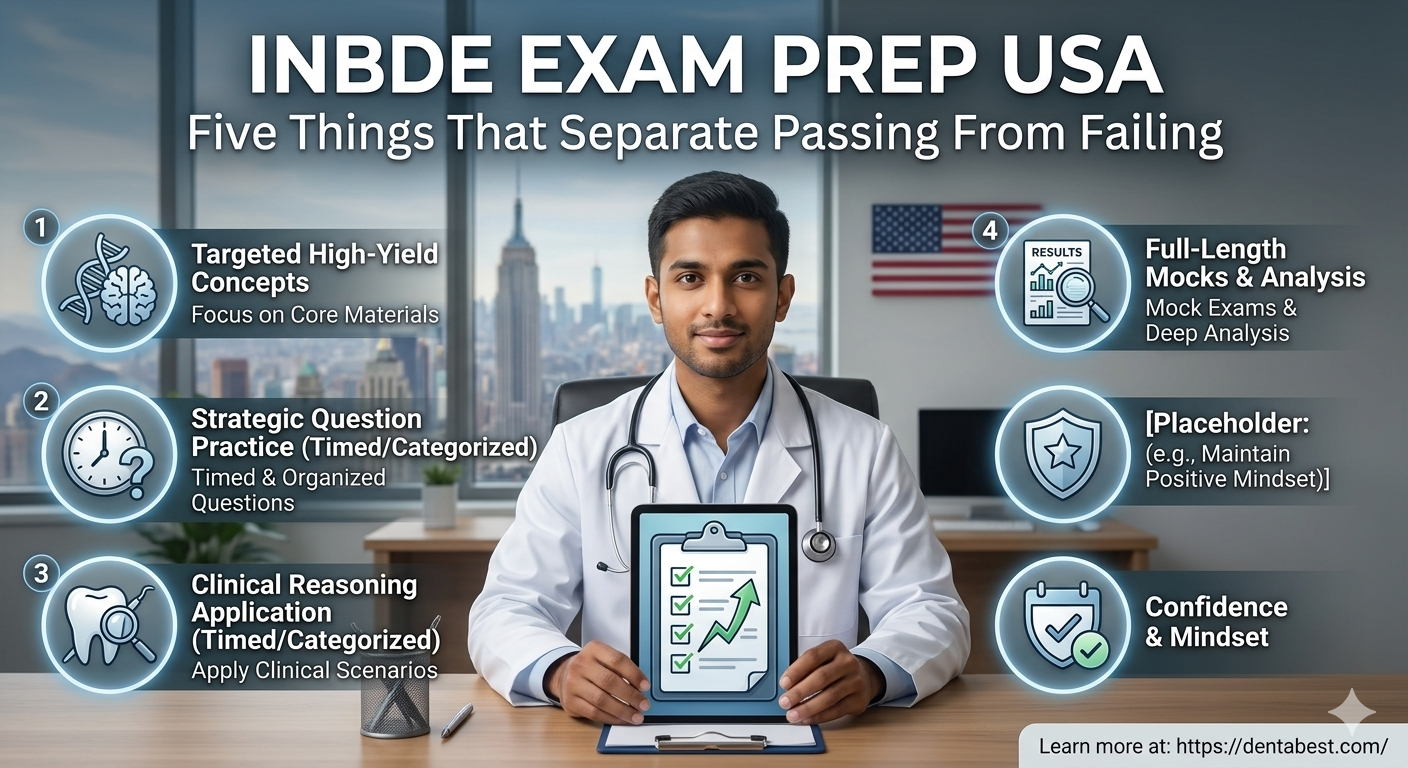
Here are the five things that consistently separate candidates who pass from those who do not.
1. They Understand What the INBDE Is Actually Measuring
Candidates who do well on the INBDE understand, from the beginning of their preparation, that this is an integrated clinical reasoning examination — not a subject-by-subject knowledge test.
They do not prepare by reviewing anatomy separately, then pharmacology separately, then oral medicine separately, as if the exam will test each subject in isolation. They know that the INBDE presents patient cases where multiple disciplines appear together, and they prepare in a way that practises exactly that kind of integrated thinking.
Candidates who struggle often spend months on subject-based review, then encounter the integrated format of the actual exam and find it significantly different from what they expected. The knowledge is there — but it has not been practised in the integrated way the exam requires.
2. Their Practice Is Active, Not Passive
There is a form of INBDE exam prep that feels productive but does not build the skills the exam tests. It involves reading through content, watching videos, making notes, and reviewing summaries. All of this creates familiarity with the material.
But the INBDE does not test familiarity. It tests application under pressure.
Candidates who pass consistently treat their INBDE practice questions as the primary learning tool, not a supplementary one. They work through questions actively — pausing on anything unclear, thinking through the options before looking at the answer, and spending as long on the review of each question as they spent on the question itself.
This is uncomfortable. It reveals gaps in a way that reading through content does not. That discomfort is the learning.
3. They Are Honest About Their Weak Areas
One of the most consistent features of candidates who pass is that they actively seek out and target their weakest areas, rather than dwelling in the areas where they already feel competent.
This sounds obvious. In practice, it is psychologically difficult. Studying content you already know feels productive and relatively pleasant. Studying content that consistently trips you up is frustrating and humbling.
But the INBDE will test your weakest areas as thoroughly as your strongest. A candidate who has achieved deep understanding in eight out of ten content areas and has surface familiarity in the other two will be caught out by those two in ways that matter.
Honest, regular diagnostic assessment — and a willingness to redirect preparation based on the results — is one of the clearest predictors of eventual success.
4. They Use Mock Exams Correctly
Candidates who pass use INBDE mock exams as diagnostic tools throughout their preparation, not as a final checkpoint at the end.
They take their first mock exam early — before they feel ready — to get an accurate baseline picture of their starting point. They take mock exams regularly through the preparation period to track progress and identify emerging gaps. And in the final weeks, they take full-length mock exams under realistic exam conditions to build the stamina and time management skills the actual examination requires.
After every mock exam, they review every wrong answer in detail — categorising the error, understanding the reasoning gap, and adjusting what they focus on in the following weeks.
Candidates who use mock exams as a final check — sitting a practice test a week before the real thing to see whether they are ready — are using them in the way that provides the least preparation value.
5. They Have Some Form of Structured Guidance
The final consistent feature is structure. Either through a formal INBDE prep course, regular sessions with an instructor, or a self-study programme with clear milestones and accountability built in.
Preparation without structure tends to follow a predictable arc: high motivation at the start, gradual drift as life competes for attention, a crisis of confidence in the middle, and a scramble at the end. The knowledge and effort are there — but they are not organised in a way that produces consistent improvement over time.
Structure does not need to mean daily instructor contact. It means having a preparation plan with clear phases and milestones, a mechanism for checking how you are actually progressing against that plan, and someone who can help you adjust when something is not working.
At DentaBest, my INBDE personalized programme provides exactly this kind of structured support — direct access to me throughout the preparation period, a plan built around your specific starting point and timeline, and regular check-ins that keep preparation honest and moving forward.
Book a free orientation and let us look at your INBDE preparation together. Sometimes the most valuable thing in a preparation is an honest outside perspective on what is working and what is not.