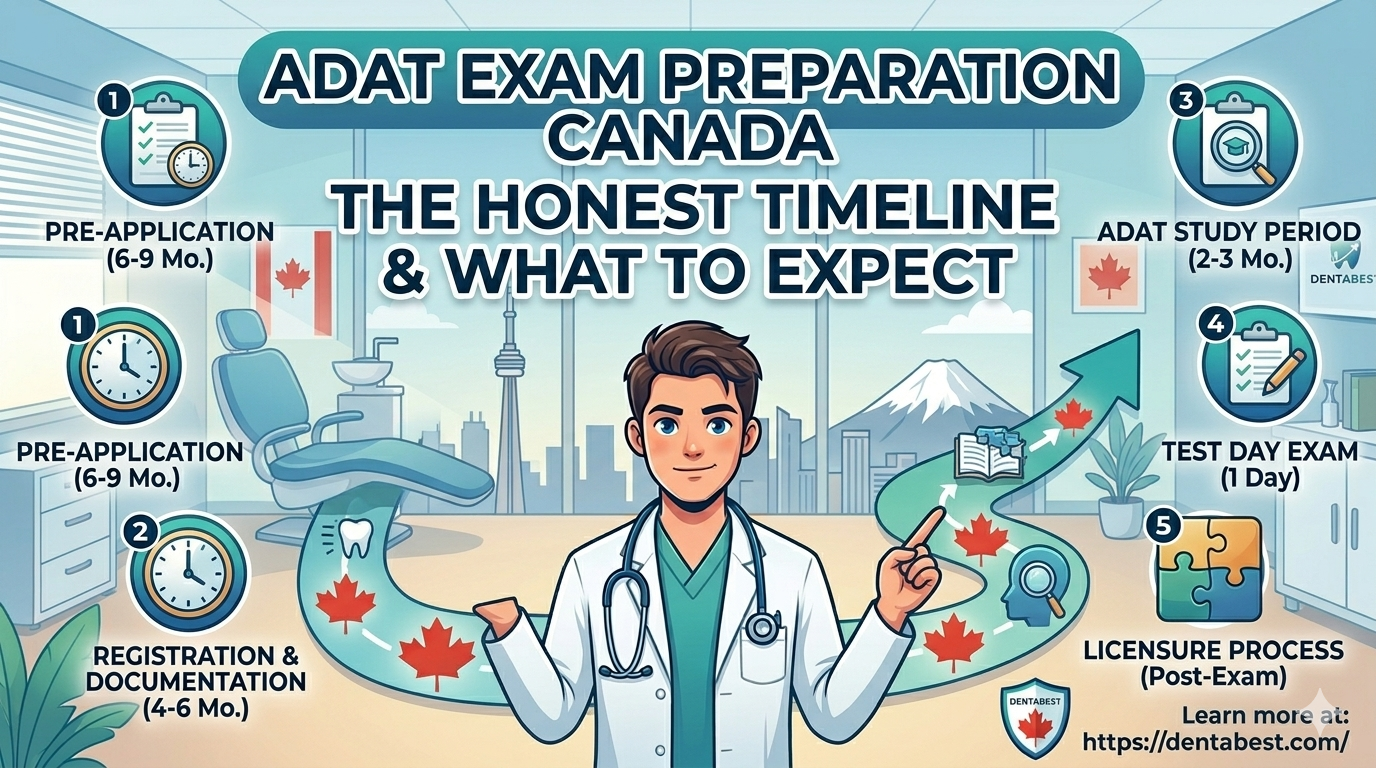
One of the most common questions I receive from internationally trained dentists in Canada is: how long will ADAT preparation take?
It is a fair question. Life does not pause for exam preparation. Most candidates are managing professional commitments, family responsibilities, and significant life complexity alongside a major academic undertaking. Knowing the realistic timeline helps you plan — and it helps you avoid one of the most common and costly mistakes in ADAT preparation, which is setting a timeline that is too optimistic.
In this post, I want to give you an honest picture of what ADAT exam preparation in Canada actually looks like from start to finish. Not the best-case scenario, but the realistic one.
The Timeline Depends on Where You Are Starting From
The ADAT covers four main sections: Survey of Natural Sciences (biology, general chemistry, organic chemistry), Perceptual Ability, Reading Comprehension, and Quantitative Reasoning.
How long preparation takes is directly determined by how far you are from exam-ready in each of these areas.
For a candidate who completed dental school relatively recently, whose basic science knowledge is still relatively fresh, and who has studied in English throughout their career, the preparation timeline is typically three to four months of consistent, focused study.
For a candidate who qualified many years ago, whose organic chemistry and biology feel genuinely distant, and who is navigating English as a second language in a technical academic context — the timeline is longer. Often five to six months, sometimes more. And that is not a problem. It is just honest planning.
Where most candidates go wrong is applying the first timeline to the second situation. The result is an exam date they are not ready for, and either a rushed final few weeks or a result that does not reflect their actual capability.
What the First Month Should Look Like
The first month of ADAT exam preparation in Canada should be diagnostic, not ambitious.
This means taking a realistic practice assessment before you have studied anything — not to feel bad about where you are, but to understand it accurately. Where is the Survey of Natural Sciences weakest? How does Perceptual Ability feel? How is your time management under pressure?
This early diagnostic gives your preparation a specific target. Without it, you are guessing which areas need the most attention based on intuition, which is almost always inaccurate.
In the first month, alongside the diagnostic, I recommend a structured content review of the highest-priority gaps identified — not a broad sweep through everything, but a targeted investment in the areas where the evidence says you need it most.
The Middle Phase — Where Most of the Work Happens
The middle phase of ADAT preparation is usually the longest and the most challenging motivationally.
This is where you are doing consistent, intensive work — content review intersected with regular practice question sessions, honest review of errors, and regular recalibration of what to focus on. Progress in this phase feels slow because it is often invisible — you are building the depth of understanding that will show up in your scores later, not immediately.
Many candidates lose confidence in the middle phase because they expected more visible progress by this point. This is entirely normal, and it is one of the reasons having some form of structured guidance or external accountability — through an ADAT coaching programme or regular check-ins with an instructor — makes such a measurable difference.
The middle phase is also where Perceptual Ability practice should be happening consistently. Not in long blocks, but regularly — thirty to forty-five minutes every few days, building the spatial reasoning skills that this section requires.
The Final Phase — When Mock Exams Become Central
In the final four to six weeks before your ADAT exam, the preparation shifts significantly toward full ADAT online mock exams and targeted consolidation.
Mock exams at this stage serve two purposes. They build the exam stamina and time management skills you will need on the day — sitting through a full exam is different from practising in shorter blocks. And they reveal the remaining gaps in your preparation with a specificity that focused study sessions cannot match.
The review of each mock exam is as important as the mock exam itself. For every question you got wrong, there is a reason. Finding that reason and addressing it in the final weeks is where meaningful score improvements most often happen.
What Candidates in Canada Often Ask About
A question I hear regularly from ADAT candidates in Canada involves the University Pathway — specifically, how strong an ADAT score you need for a realistic chance at a program.
The honest answer varies significantly by program. The competitive range at most Canadian dental schools is above the 75th percentile. Some programs are more competitive than that. This means that for most candidates, a score that is above average is not sufficient — and preparation needs to be aiming for a level of performance, not just a passing result.
This matters for the timeline. Preparing to reach a specific competitive score level requires more time and more targeted work than preparing simply to pass.
At DentaBest, I work with candidates in Canada who are targeting competitive ADAT scores for the University Pathway. Book a free orientation session and let us look at where you are, what score you are realistically targeting, and what preparation approach will get you there.